
Sectoral and Thematic Funds: When to Consider Investing in 2026
Understand how sectoral and thematic mutual funds work, their key differences, and when to consider adding them to your portfolio in 2026. A complete guide for Indian investors.
February 10, 2026
6 min read
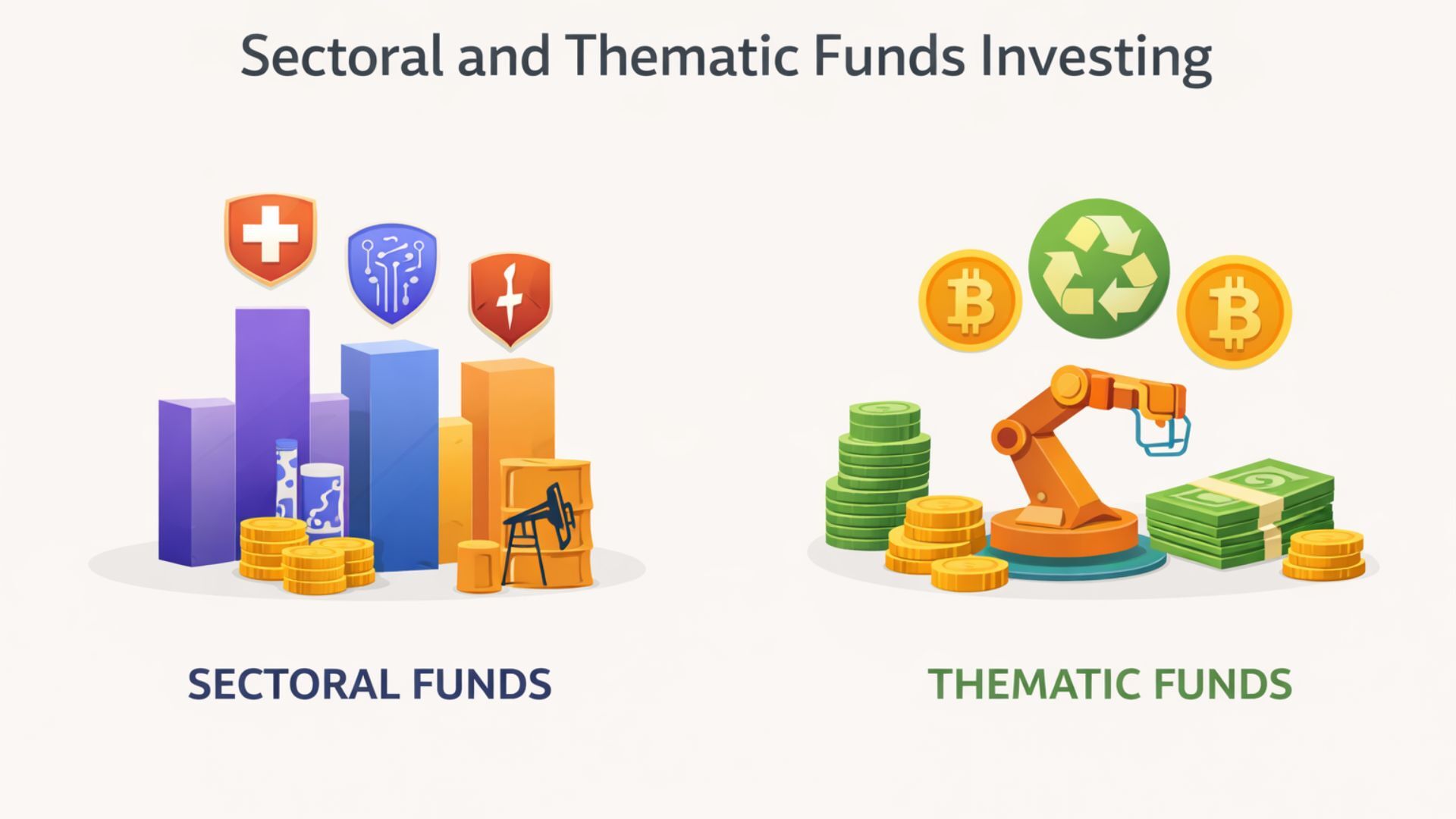
Sectoral and thematic mutual funds have gained significant attention in India over the past few years. As investors look beyond traditional diversified equity funds, these categories offer a way to participate in specific growth stories and macro trends shaping the Indian economy.
But these funds are not for everyone. Understanding when and how to use them can make a meaningful difference to your portfolio outcomes.
What Are Sectoral Funds?
Sectoral funds invest primarily in a single industry or sector of the economy. As per SEBI guidelines, these funds must allocate at least 80% of their assets to equity and equity-related instruments of companies within that sector.
Examples include banking and financial services funds, IT sector funds, pharma and healthcare funds, and infrastructure funds. When the chosen sector performs well, these funds can deliver strong returns that outpace broader market indices.
What Are Thematic Funds?
Thematic funds take a broader approach. Instead of focusing on one sector, they invest across multiple sectors that are connected by a common macro theme. Examples include themes like digital economy, energy transition, manufacturing, consumption, and ESG (Environmental, Social, and Governance).
A thematic fund focused on “Make in India,” for instance, could hold stocks across manufacturing, infrastructure, defence, and logistics. This cross-sector approach provides wider participation in a growth narrative while offering relatively better diversification than a pure sectoral fund.
Key Differences Between Sectoral and Thematic Funds
| Parameter | Sectoral Funds | Thematic Funds |
|---|---|---|
| Investment focus | Single industry | Multiple sectors tied to a theme |
| Diversification | Lower (concentrated in one sector) | Moderate (spread across related sectors) |
| Risk level | Higher | Moderate to high |
| Ideal for | Strong conviction in a specific sector cycle | Participation in a broad macro trend |
| SEBI mandate | Min 80% in one sector | Min 80% aligned to the stated theme |
Why Investors Are Looking at These Funds in 2026
India’s economic landscape in 2026 presents several compelling themes. Government spending on infrastructure, the growing digital economy, rising healthcare awareness, and the push for domestic manufacturing are creating sector-specific tailwinds that diversified funds may not fully capture.
For investors who have a view on where the next wave of growth is likely to come from, sectoral and thematic funds offer a way to position their portfolios accordingly.
Several sectors have shown promising signals heading into 2026:
- Banking and financial services: Strong credit growth, improved asset quality, and supportive monetary policy
- Healthcare: Rising health insurance penetration, hospital expansion, and growing wellness spending
- IT and digital: Gradual AI adoption, stabilising global IT budgets, and improving deal conversions
- Infrastructure and manufacturing: Continued government capex push and the PLI (Production Linked Incentive) scheme
When to Consider Sectoral and Thematic Funds
You have a long-term investment horizon. These funds work best when you can stay invested for 5 to 7 years or more. Sectors and themes go through cycles, and a longer horizon gives your investment time to ride through short-term volatility.
You follow market and economic trends. If you keep track of policy changes, government budgets, and industry developments, you are better positioned to identify sectors and themes that may benefit. For example, increased defence spending may support a defence-themed fund, while rising digital adoption supports technology-focused funds.
You want to complement your core portfolio. The core-satellite strategy is one of the most effective ways to use sectoral and thematic funds. Your core portfolio (70 to 80% of your equity allocation) stays in diversified large-cap, flexi-cap, or multi-cap funds. The satellite allocation (20 to 30%) goes into sectoral or thematic funds that align with your growth view.
This approach lets you participate in specific opportunities without putting your entire portfolio at risk.
You are comfortable with higher volatility. These funds can swing more than diversified funds during market corrections. If you understand this and have the patience to hold through cycles, the potential rewards can be meaningful.
How to Evaluate Sectoral and Thematic Funds
Before investing, consider these factors:
- Fund track record: Look at the fund’s performance over at least 3 years relative to its benchmark and category peers
- Expense ratio: Compare costs across similar funds. Lower expenses mean more of the returns stay with you
- Fund manager expertise: A fund manager with deep sector knowledge can make a significant difference in stock selection
- Theme viability: For thematic funds, assess whether the theme has a multi-year runway. Short-lived trends may not sustain performance
- SIP or lump sum: SIPs (Systematic Investment Plans) can help smooth your entry across market conditions, reducing timing risk
A Practical Approach for 2026
If you are considering adding sectoral or thematic exposure to your portfolio, here is a simple framework:
- Start with your core. Ensure your diversified equity allocation is well established before adding satellite positions
- Pick themes you understand. Invest in sectors where you have reasonable knowledge and conviction
- Limit exposure. Keep your combined sectoral and thematic allocation within 20 to 30% of your equity portfolio
- Use SIPs. Phased investing reduces the impact of market timing, which is especially important for cyclical sectors
- Review regularly. Monitor your holdings quarterly. If the fundamental thesis behind a sector or theme changes, be ready to reallocate
Frequently Asked Questions
Are sectoral funds riskier than thematic funds?
Yes, generally. Sectoral funds concentrate on a single industry, so their performance depends entirely on that sector’s cycle. Thematic funds spread investments across multiple related sectors, offering somewhat better diversification.
Can beginners invest in sectoral and thematic funds?
These funds are better suited for investors who have some market experience and can tolerate higher volatility. If you are new to mutual funds, it is advisable to build a diversified core portfolio first.
What is the ideal holding period for these funds?
A minimum of 5 to 7 years is recommended. Sectors and themes are cyclical, and a longer horizon increases the likelihood of capturing a full growth cycle.
_Disclaimer: Mutual fund investments are subject to market risks. Read all scheme-related documents carefully before investing. Past performance is not indicative of future results. This content is for educational and informational purposes only and should not be construed as investment advice._