
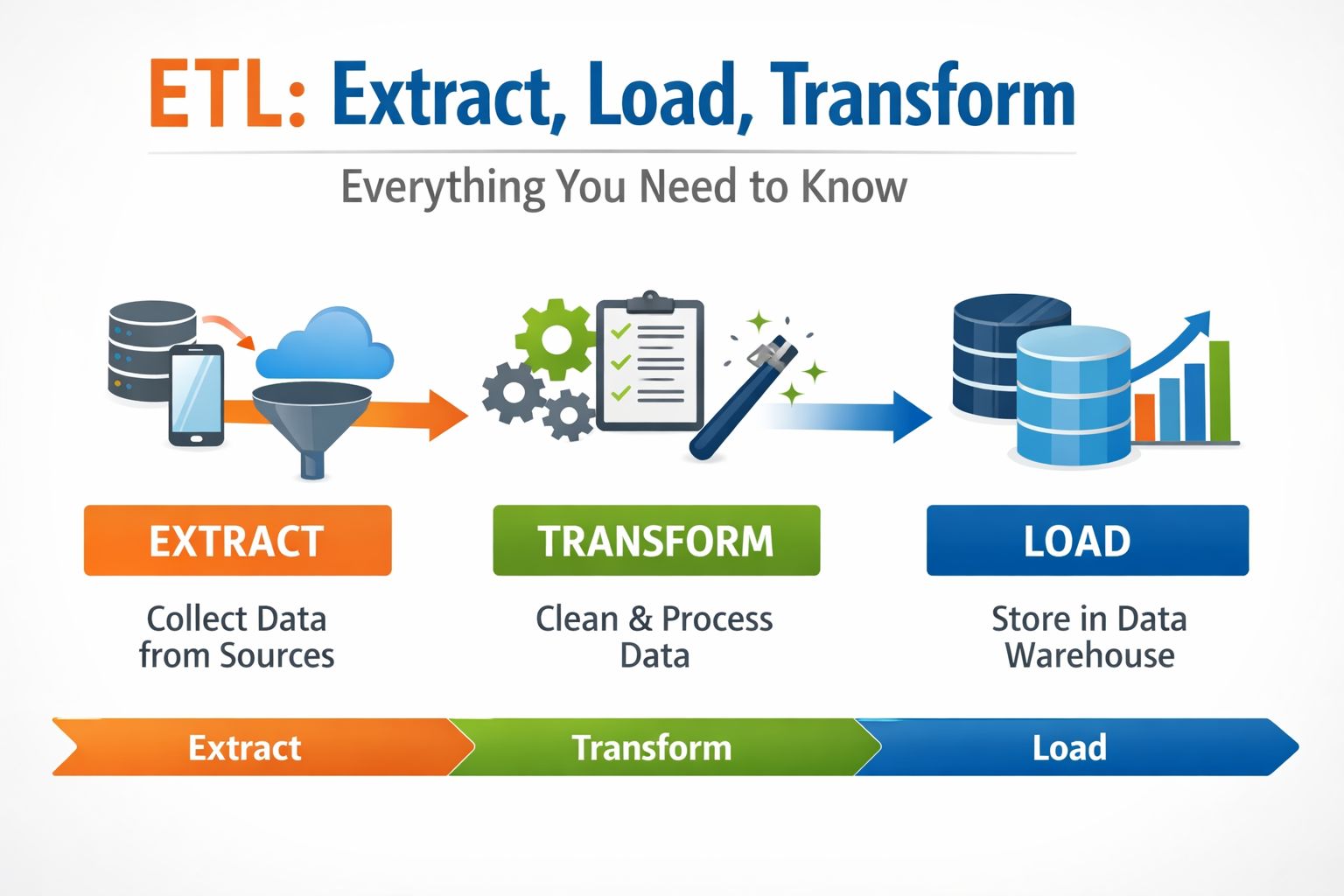
In Simple words, ETL stands for “Extract, Transform, and Load.”
To consolidate data from various sources into a single, centralized database in the context of data warehousing, the first step is to:
- EXTRACT data from its original source
- TRANSFORM data by normalizing it, combining it, and ensuring quality, to then
- LOAD data into the target database.
Generally an ETL process collects and refines different types of data, then delivers the data to a data lake or data warehouse such as Redshift, Azure, or BigQuery.
Such type of ETL tools allows companies to gather data from multiple sources and consolidate to a centralized destination.
As a result, the ETL process plays a critical role in producing business intelligence and executing broader data management strategies. We are also seeing the process of Reverse ETL become more common, were cleaned and transformed data is sent from the data warehouse back into the business application.
Did you know about ETL
The ETL process comprises 3 steps
- data extraction
- data transformation
- data loading
Step 1: Extraction
Most businesses manage data from a variety of data sources and use a number of data analysis tools to produce business intelligence. To execute such a complex data strategy, the data must be able to travel freely between systems and apps.
Before data can be moved to a new destination, it must first be extracted from its source. In this first step of the ETL process, structured and unstructured data is imported and consolidated into a single repository. Volumes of data can be extracted from a wide range of data sources, including:
- Mobile devices and apps
- CRM systems
- Data storage platforms
- Data warehouses
- Analytics tools
- Existing databases and legacy systems
- Cloud, hybrid, and on-premises environments
- Sales and marketing applications
While manual data extraction can be performed by a team of data engineers, it is a time-consuming process and susceptible to errors. In contrast, ETL tools automate the extraction process, leading to a more efficient and dependable workflow.
Step 2: Transformation
In this phase of the ETL process, rules and regulations can be implemented to ensure data quality and accessibility. These rules can help enforce data governance and compliance measures, as well as assist the company in meeting reporting requirements.The process of data transformation comprises several sub-processes:
- Cleansing — inconsistencies and missing values in the data are resolved.
- Standardization — formatting rules are applied to the dataset.
- Deduplication — redundant data is excluded or discarded.
- Verification — unusable data is removed and anomalies are flagged.
- Sorting — data is organized according to type.
- Other tasks — any additional/optional rules can be applied to improve data quality.
Transformation is widely regarded as a critical component of the ETL process. It plays a pivotal role in enhancing data integrity by eliminating duplicates and ensuring that raw data is fully compatible and prepared for its destination.
Data transformation processes involve various operations such as data cleansing,normalization, aggregation, and formatting. By performing these transformations, organizations can enhance data quality, consistency, and usability, making it reliable and suitable for analysis and decision-making purposes.
Step 3: Loading
The final step in the ETL process is to load the newly transformed data into a new destination (data lake or data warehouse.) Data can be loaded all at once (full sync) or at scheduled intervals (incremental sync).
Full Sync — In an ETL full loading scenario, everything that comes from the transformation assembly line goes into new, unique records in the data warehouse or data repository. Though there may be times this is useful for research purposes, full loading produces datasets that grow exponentially and can quickly become difficult to maintain.
Incremental Sync — A less comprehensive but more manageable approach is incremental loading. Incremental loading compares incoming data with what’s already on hand, and only produces additional records if new and unique information is found. This architecture allows smaller, less expensive data warehouses to maintain and manage business intelligence.[](/blog/want-to-know-what-people-are-searching-on-youtube-globally)
Using ETL for BI Applications
Data strategies have become increasingly intricate, mainly due to the proliferation of Software-as-a-Service (SaaS) solutions that provide companies with access to data from a wide range of sources. ETL tools play a vital role in transforming vast volumes of data into actionable business intelligence.
Let’s consider the example of a manufacturer. They have access to diverse sets of raw data, including data generated by sensors within their facilities and machines on the assembly line. Additionally, the company collects data from various departments such as marketing, sales, logistics, and finance, often utilizing SaaS tools to gather this information.
By leveraging ETL tools, the manufacturer can streamline the process of consolidating and transforming these data sources into meaningful insights. This enables them to gain a comprehensive understanding of their operations, identify trends, make informed decisions, and optimize their business processes across multiple domains.
All of that data must be extracted, transformed, and loaded into a new destination for analysis. ETL enables data management, business intelligence, data analytics, and machine learning capabilities by:
Delivering a single point-of-view
Managing multiple data sets in a world of enterprise data demands time and coordination. This can result in inefficiencies and delays. ETL combines databases and various forms of data into a single, unified view. This makes it easier to aggregate, analyze, visualize, and make sense of large datasets.
Providing historical context
ETL allows the combination of legacy enterprise data with data collected from new platforms and applications. This produces a long-term view of data so that older datasets can be viewed alongside more recent information.[](/blog/android-vitals-automatic-update)
Improving efficiency and productivity
ETL Software automates the process of hand-coded data migration and ingestion, making it self-service. As a result, developers and their teams can spend more time on innovation and less time managing the painstaking task of writing code to move and format data.
ELT — the next generation of ETL
ELT is a modern take on the older process of extract, transform and load, in which transformations take place before the data is loaded. Over time, running transformations before the load phase is found to result in a more complex data replication process. While the purpose of ETL is the same as ELT, the method is evolved for better processing.
ELT vs ETL
Traditional ETL (Extract, Transform, Load) software historically involved extracting and transforming data from various sources before loading it into a data warehouse or data lake. However, with the emergence of cloud data warehouses, the need for data cleanup on dedicated ETL hardware before loading into the data warehouse or data lake has diminished.
The cloud infrastructure enables a shift towards an ELT (Extract, Load, Transform) approach, where the data extraction and loading processes are prioritized, and the transformation step is performed directly within the cloud data warehouse. This push-down ELT architecture offers several advantages, including improved scalability, reduced data movement, and the ability to leverage the computational power of the cloud environment for efficient data transformation.
In this modified pipeline, the two primary changes are extracting data from source systems and loading it into the cloud data warehouse or data lake, followed by performing the necessary transformations within the cloud environment. This approach takes advantage of the cloud’s flexibility and computing capabilities, simplifying the overall ETL process and enhancing data integration and analysis capabilities.