
For your marketing campaigns to be successful, knowing your customers should be the number one priority. The first step is to shift your focus from generating more clicks to retention, loyalty, and customer relationships. What is a better way to do so than segmenting your customers into distinctive groups based on their age, gender, or geography?
One of the most popular and effective customer segmentation analysis methods is the RFM approach. So, let’s understand what RFM analysis is and how you can use it.
What is RFM in Marketing?
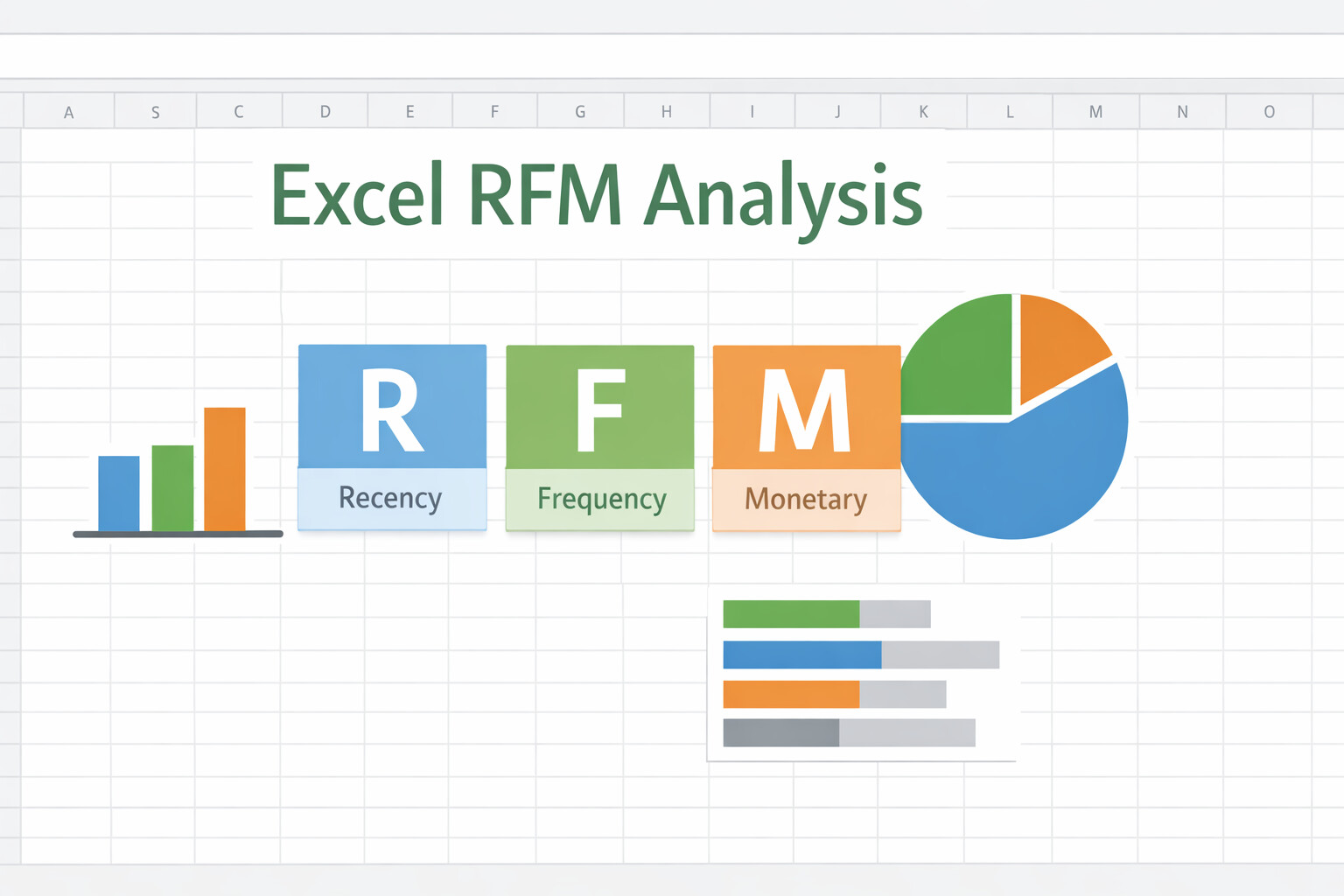
RFM full form is recency frequency monetary. By using the RFM metrics, you can analyze the value of your customer as they act as an indicator of a customer’s behavior. The primary aim of using the RFM marketing methodology is to understand and categorize your customers based on their recent purchases, transaction frequency, and overall spending.
Both frequency and monetary value affect a customer’s lifetime value whereas recency affects the customer’s retention rate. By using this customer analysis segmentation method, businesses can implement effective marketing strategies.
Therefore, with RFM, can identify the following facts about your customers:
- Recent buys = More likely to respond to promos
- Buying often = More satisfied and engaged
- Money spent = Separates big spenders from low-value buyers
What is RFM Segmentation and Analysis?
RFM segmentation is a marketing analysis method that helps in identifying customers based on their recency, frequency, and monetary value. It helps businesses categorize customers into different segments based on their specific engagement and spending patterns. Through this, they can create targeted and personalized marketing strategies.
By using these metrics, marketers can perform RFM analysis to target specific clusters of customers. For instance, using RFM, a marketer can identify groups of customers for special treatment. This approach generates higher response rates, increased loyalty, and customer lifetime value.
The customer segment analysis can be done by using the data of existing customers. Information like purchase history, demographics, browser history, and prior campaign response patterns can be used for accurate analysis.
Benefits of Using RFM
RFM analysis is popular for numerous reasons. The primary reasons include:
- Clear and Objective Insights: It relies on numbers, providing an informative and straightforward overview of customers. By assigning numerical values to recency, frequency, and monetary values, it provides a clear picture of customer behavior with ambiguity.
- Ease of Implementation: Marketers can effectively use RFM segmentation without relying on complex tools or needing specialized data science expertise. This accessibility allows for quicker adoption and utilization within marketing strategies.
- Intuitive Understanding: RFM analysis is intuitive in nature. The segmentation output can be easily understood and interpreted, providing actionable insights without the need for elaborate explanations or in-depth training. [](/blog/what-are-demand-side-platforms)
How to Implement RFM Analysis in Customer Segmentation?
By using the segmentation model, you can identify:
- Your best customers
- Pinpoint who might stop using your services
- Discover the customers who could become valuable
- Keep track of individuals you should retain
- Identify who might respond well to campaigns
Let’s understand how RFM works by using an example of an online e-commerce company:
- Recency
The company looks at when customers make their purchases. For example, a customer who bought a dress in the last 10 days gets a higher recency score as compared to another customer who purchased a dress 2 months ago.
- Frequency
The company examines how often customers make purchases. RFM scoring in terms of frequency is higher for customers who buy dresses every month compared to customers who make occasional purchases throughout the year.
- Monetary Value
Lastly, the company evaluates the total amount each customer spends on their purchases. Customers who consistently buy expensive or multiple items at a time receive a higher monetary value score.
By combining the scores, the e-commerce company can segment customers into categories like “Recent and Regular Buyers,” “Infrequent High-Spenders,” and “Frequent Low-Spenders,” among others.
This segmentation allows the company to tailor their promotions or recommend specific categories of clothing to each group based on their buying behavior which helps in creating more personalized and effective marketing RFM strategies.
Recency, Frequency, and Monetary Analysis
One of the critical questions when it comes to RFM analysis is whether it is fair to average out the individual R, F, and M scores for each customer and assign them to different segments. Depending on the nature of your business, you can adjust the scores according to how important each variable is for your business. For example:
- Big items like appliances and furniture that are bought infrequently should focus on recency and monetary value and not frequency as people don’t purchase them often.
- In fashion and retail, you can prioritize recency and frequency over monetary value because frequent buyers matter the most in these industries.
- Content applications like Netflix and Hotstar can focus more on engagement and frequency for binge-watchers or recency and frequency for regular viewers.
So, suppose you were using a scoring scale of 1-5 with respect to R x F x M = 5 x 5 x 5, making the total score of 125. You can consider only two factors and consider the total score to be 25. This can help you simplify the understanding of customer behaviors as per different markets and industries. [](/blog/what-are-hybrid-mobile-apps)
How to Build an RFM Model?
RMF modeling plays a crucial role in marketing where by using recency frequency monetary where can perform customer segmentation. It mainly looks at three things- how recently people have bought things, how often they buy, and how much they spend.
As a marketer, you can build an RFM model, a structured methodology through which you can collect and analyze customer data. Once you have gathered the relevant data like recency of purchase, frequency of transactions, and the monetary value associated with each translation, you can assign numerical scores to each parameter.
The scoring process helps in categorizing customers into different segments. Additionally, you can also automate the process by using the right tools and generate more accurate results. For instance, you can use a customer segmentation dataset and do RFM analysis Python to gain in-depth insights.
Now, let’s take a look at the following steps on how you can build your RFM customer analysis model:
Step 1: Assign RFM Values
The foremost step in building an RFM model is to assign Recency, Frequency, and Monetary values to each customer. The primary task is to gather valuable data regarding the customer purchasing pattern. The raw data may also be available in the company’s CRM which can be compiled in an Excel spreadsheet or database:
- Recency measures how recently customers made purchases. Here, you can use days for your calculations. Alternatively, you can use months, weeks, or even hours, whatever is relevant to your business.
- Frequency defines the total number of transactions a customer makes within a defined timeframe.
- Monetary value focuses on the total spending across all the transactions during a specific period.
Step 2: Divide Customers into Tiers
After your data collection, the next step is to segment customers based on their behavior. This segmentation is critical to understanding the different customer habits. It is usually recommended to divide the customers into four tiers for each R, F, and M dimension so that each customer can be assigned to one tier in each dimension. Therefore:
- Recency: R-Tier-1 (most recent), R-Tier-2, R-Tier-3, R-Tier-4 (least recent)
- Frequency: F-Tier-1 (most frequent), F-Tier-2, F-Tier-3, F-Tier-4 (only one transaction)
- Monetary: M-Tier-1 (highest spend), M-Tier-2, M-Tier-3, M-Tier-4 (lowest spend)
This creates 64 unique customer segments (4x4x4). You can also use three tiers (27 segments) if it suits the requirements of your business, however, it is usually not recommended.
Step 3: Create Customer Groups
The third step comprises grouping customers to whom specific types of communications will be sent, based on the RFM segments in which they appear. Let’s understand this with a few examples:
- Best Customers: This group has customers who are in R-Tier-1, F-Tier-1, and M-Tier-1 (can also be indicated as 1-1-1). This indicates that they have transacted recently, they purchase often and more than other customers.
- High-Spending New Customers: This group consists of customers who belong to the R-Tier-1, F-Tier-4, and M-Tier-1 (1-4-1) as well as R-Tier-1, F-Tier-4, and M-Tier-2 (1-4-2). These customers have transacted only once, but very recently, and spent a lot.
- Lowest-Spending Active Loyal Customers: This group has customers in segments of R-Tier-1, F-Tier-1, and M-Tier-3 (1-1-3) followed by R-Tier-1, F-Tier-1, and M-Tier-4 (1-1-4). This means that they have transacted recently and purchase often, but spend the least.
- Churned Best Customers: This group consists of customers in groups of R-Tier-4, F-Tier-1, and M-Tier-1 (4-1-1), R-Tier-4, F-Tier-2, and M-Tier-1 (4-2-1), and R-Tier-4, F-Tier-2, and M-Tier-2 (4-2-2). This indicates that the customers have transacted frequently,and have spent a lot, however, it’s been a long time since they have purchased anything.
Related : What are Interstitial Ads?: Everything You Need to Know About Interstitial Banners and Ads
Therefore, you can execute customer segment analysis with respect to the different groups of customers and focus on the ones that align with your business objective and retention goals.
Step 4: Curate Specific Messaging
The last and most important step is to tailor messages for each customer group. This helps marketers connect more effectively with customers based on their behavior. By considering the four segment examples in step 3, your messages can focus on:
- Best Customers: Make them feel valued and appreciated. Understand their preferences to curate more personalized communication since they contribute the most to revenue.
- High-Spending New Customers: Give these customers special attention, incentives, and appreciation to encourage continued engagement after their initial high-value purchase.
- Lowest-Spending Active Loyal Customers: Design campaigns to make them feel valued and motivate them to increase their spending. Reward their loyalty and consider specific offers if they refer their friends or family.
- Churned Best Customers: Although these customers haven’t recently purchased anything, you should try to reconnect. Use known preferences from past transactions and personalize the communication to regain their engagement.
Conclusion
Thus, RFM is a data-driven customer segmentation strategy that allows marketers to make tactical decisions. By using the RFM model you can quickly identify and segment users into homogeneous groups. This can, in turn, help in creating differentiated and personalized marketing strategies to improve user engagement and improve customer retention rates.
Additionally, you can implement machine learning techniques in the segmentation process to enhance the results. It can help identify more unique customer patterns and insights, thereby, helping to create distinctive marketing strategies.