
Understanding the Attribution Model In Digital Marketing
Learn about attribution models in digital marketing, how they work, and how to choose the right one to measure campaign performance and customer journeys effectively.
July 26, 2025
7 min read
Attribution model marketing is a strategy that allows marketers to analyse and assign credit to marketing touchpoints. These touchpoints occur at specific steps of the customer journey and aid in converting potential leads.
What is an Attribution Model?
Marketing attribution modelling helps in determining the impact of various marketing efforts. A marketer uses different channels such as email campaigns, PPC, and social media, among others and different methods or touchpoints like specific ads, blog posts, social media posts, and emails.
With attribution marketing, you can identify the contribution of these efforts, leading to the conversion or action (known as event) of a user on a mobile app. A marketer uses different types of attribution models marketing to assess which channel and touchpoints have influenced the decision of customers that has resulted in the conversion.
It is executed by analysing data about user behaviour. This includes evaluating app instals, in-app purchases (IAPs), clicks and impressions as well as tracking the source of that behaviour back to marketing effort.
What is the Purpose of Attribution?
By assigning credit to your marketing channels and touchpoints, you can improve your chances of converting more prospects. You can do so by identifying areas of the buyer’s journey that you can improve or determine the ROI for each channel or touchpoint.
You can also pinpoint the effective ways to spend your marketing budget and tailor your marketing campaigns or content to your customer personas.
Advantages of Attribution Modelling
Attribution modelling plays a major role in mobile marketing measurement. An attribution model helps marketers understand which campaigns or tactics were the most effective in driving user engagement, retention, and revenue. It helps advertisers recognise the best-performing traffic sources that are delivering value.
When a marketer can identify these successful channels and tactics, they can optimise the mobile marketing strategies. This further helps in effectively allocating resources to achieve the desired outcome.
Therefore, marketing attribution results in: Optimised marketing spend Increased ROI Improved personalisation Better product development Optimised campaigns or content
What are the Different Marketing Attribution Models
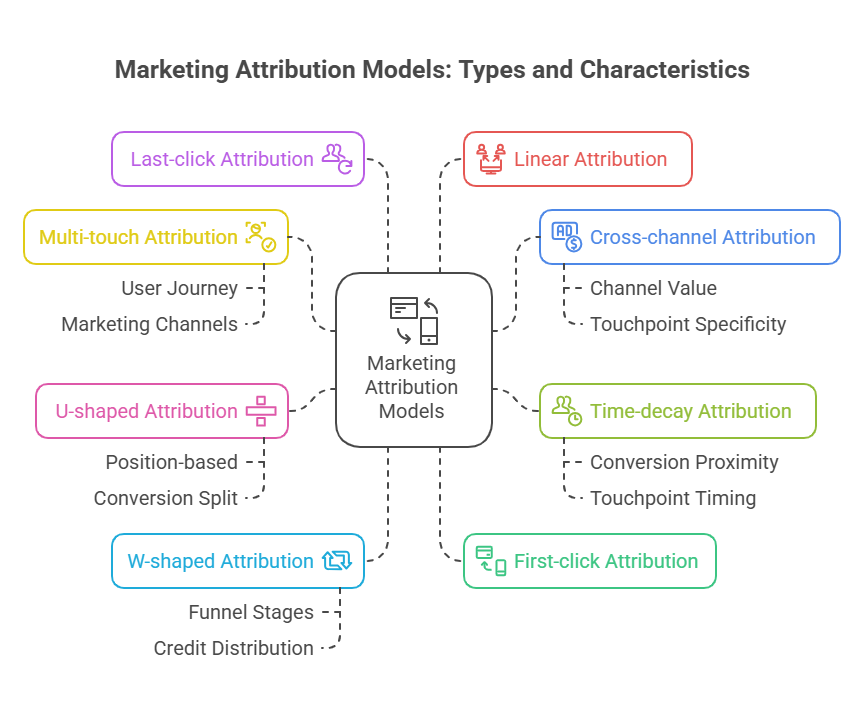
It is crucial to understand how different attribution models in digital marketing can be used. Let’s dive deeper into understanding these models:
First-click Attribution
Also known as the first-touch attribution model, it awards credit to a user’s first point of contact with a campaign. This single-touch attribution model works on the assumption that the first touchpoint plays the most influential role in user decision-making when it comes to conversion.
Last-click Attribution
The last-click attribution, also known as the last-touch or last-interaction attribution model, awards credit to the final point of contact a user has with a campaign. This single-touch attribution model is based on the assumption that the last touchpoint plays a key role in customer conversion.
Multi-touch Attribution
The multi-touch model assigns different weights to different traffic sources for an advertising interaction. This leads to multiple channels benefiting when a user interacts with a campaign. Compared to the single-touch attribution model, this model provides a deeper understanding of the user journey and the different marketing channels. A mobile marketer can optimise their campaigns accordingly and allocate resources more efficiently.
Cross-channel Attribution
This attribution model is often used interchangeably with multi-touch attribution. However, with cross-channel attribution, the main difference is the focal point is the value assigned to each marketing channel as it doesn’t look at specific touchpoints within these channels.[](/blog/what-is-an-offerwall)
Linear Attribution
Linear attribution is a multi-touch attribution model that gives equal credit to all channels and touchpoints that a customer has interacted with throughout the buyer journey.
Time-decay Attribution
This attribution model gives credit to all the touchpoints that have contributed to a conversion. It also considers the time that each touchpoint occurred, keeping note of the touchpoints that happened closest to the time of conversion.
U-shaped Attribution
Also known as the position-based attribution model, it splits the credit for conversion between the first and the last touchpoints.
W-shaped Attribution
The W-shaped attribution model gives the most credit to the first touchpoint, last touchpoint, and mid-funnel touchpoint before a conversion. The rest of the touchpoints are given equal credit as per this model.
How to Choose the Attribution Model?
There isn’t necessarily the best model among the different digital marketing attribution models. You need to choose a model depending on the needs and requirements of your client. In certain scenarios, you can use different models to compare the performance of a marketing campaign.
For instance, your agency can decide on using one model to gain insight to improve the campaign further and choose another one for reporting and analysis. As your client’s business needs evolve, you can switch between various attribution modelling marketing to meet the required goals and complete the sales cycle.
Make your decision by analysing the stages in your client’s sales funnel, marketing touchpoints, their business goals and expectations. Choose the model which would provide your client with better and more accurate results.[](/blog/sdks-meaning-types-tools-and-how-to-use)
How to Find Attribution Model in Google Analytics?
Google Analytics is one of the most popular tools used for identifying attribution in digital marketing. Although this tool uses last-interaction attribution by default, you can the option to compare different attribution models in your account.
Follow the steps to find your attribution model reports in Google Analytics:
Step 1: Log on to your client’s Google Analytics account.
Step 2: Click on the Model Comparison Tool under Attribution. You will find this option on the left-hand side of the account.
Compare each model to see the value each channel delivers under different attribution models. If customising your clients’ links with UTM codes (Urchin Tracking Module, a web analytics software that serves as the base for Google Analytics), click on Source. This opens up the value assigned to each source being tracked. Observe more than one model to understand the value of all marketing channels that lead to conversions.
Conclusion
Thus, attribution modelling helps a marketer to understand the impact of a client’s marketing channels. By using different models, you can analyse the outcome and make informed decisions to improve customer decision-making and successful conversions.