
Data integrity helps companies ensure the quality of the data and ensure they have accurate and correct data in their database management systems (DBMS). Let’s understand what data integrity means, its types, and how you can maintain it.
Define Data Integrity
Data integrity definition refers to the accuracy, consistency, and completeness of data throughout its lifecycle. It is of critical importance as organizations can ensure the integrity of data and keep it protected against data loss or data leaks.
Maintaining the integrity of data over time and across different formats is a continual process that involves different rules and standards.
Why is Data Integrity Important?
The importance of data integrity in DBMS increases with the rise in data volumes. Your company is most likely to receive large as well as complex datasets from various sources. It can be historical data and real-time streaming data.
Major companies are becoming more reliant on data integration and the ability to interpret information accurately as it aids in elevating business performance. The reason behind this is that the data helps in predicting consumer behavior, evaluating market activities, and even help in mitigating potential data security risks.
However, incorrect or incomplete data can lead to bad decisions which can impact your time, effort, and expenses. Moreover, the loss of sensitive data amplifies the negative impact on your organization.
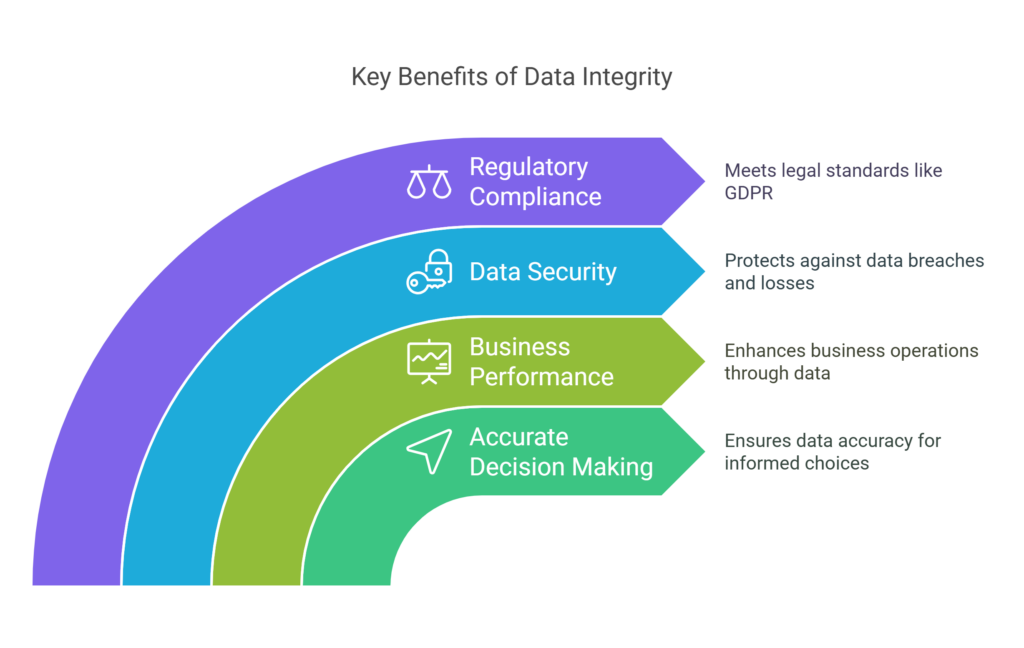
The key benefits of maintaining database integrity as a part of your data governance framework are:
- Supporting adequate data insights and decisions
- Ensuring regulatory compliance such as the General Data Protection Regulation (GDPR)
- Protecting your customers’ and other data subject’s information
What are the Types of Data Integrity?
Organizations can maintain data integrity through integrity constraints. This defines the rules and process for data deletion, insertion, and update of information. The definition of data integrity can be enforced in both hierarchical and relational databases. It can include customer relationship management (CRM), enterprise resource planning (ERP), and supply chain management systems (CMS) systems.
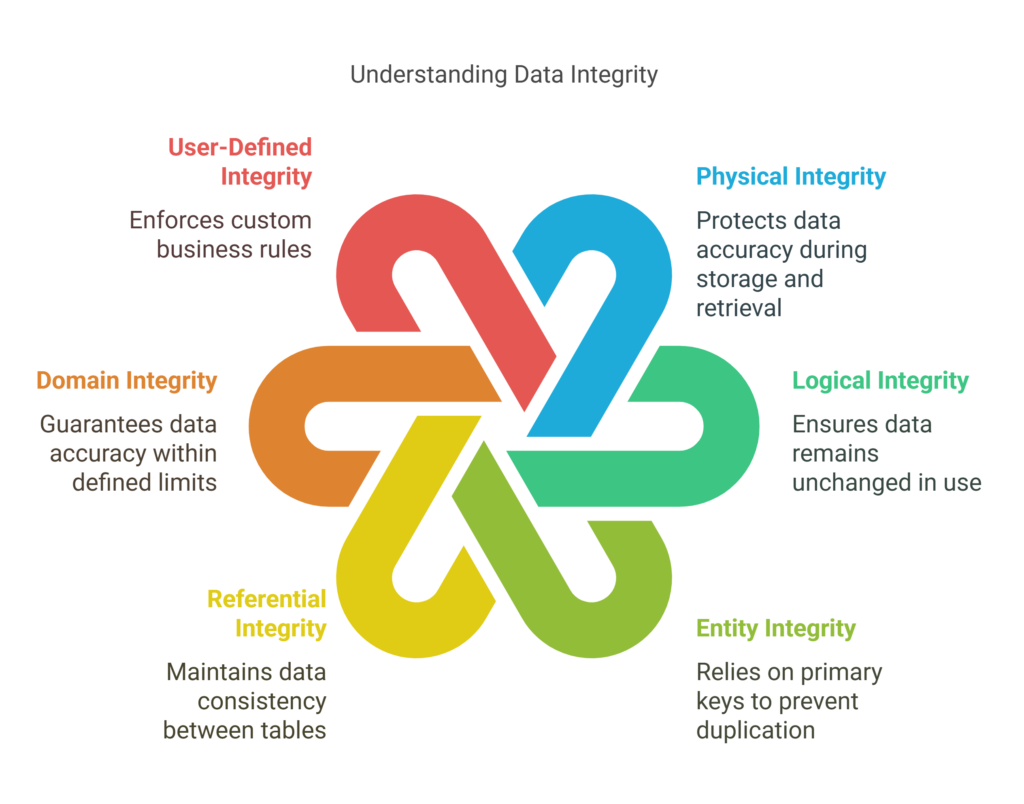
The two main types of data integrity are:
- Physical Integrity
Physical integrity focuses on protecting the accuracy, correctness, and wholeness of data when it is stored and retrieved. Physical integrity can be compromised because of external sources like power outages, natural disasters, and hackers.
It can also be impacted due to internal sources like storage erosion, design flaws, or human erosion. When the dataset is affected, it usually cannot be used.
- Logical Integrity
Logical integrity makes sure that data remains unchanged when it is being used in different ways through relational databases. Logical integrity can also be negatively affected due to human errors and design flaws. However, a dataset can be overwritten with new data and reused if it has logical errors.
Logical integrity comes in four different formats:
- Entity Integrity
Entity integrity is a feature of relation systems that store data within tables. It can be used and linked in multiple ways. Most importantly, entity integrity relies on primary keys and unique values that are created to identify a piece of data. This process also prevents data from being duplicated. It also ensures that there can’t be NULL because then you can’t uniquely identify the row of the other fields in the row.
For instance, you may have two customers with the same name and age. Without the customer ID which is the unique identifier in this case and works as the primary key, you could have errors or confusion when pulling the data.
- Referential Integrity
Referential integrity can be defined as a series of processes that ensure data remains stored and used uniformly. This format helps in maintaining data consistency between two tables. The rules and procedures are embedded into the database structure as foreign keys can be used. This ensures accurate data entry and no duplication of data.
- Domain Integrity
Domain integrity in DBMS is a series of processes that guarantees the accuracy of a piece of data within a domain. A domain, in turn, can be classified by a set of values that a table’s columns are allowed to contain. It also comprises constraints and measures that limit the amount, data type, and format that can be entered.
- User-Defined Integrity
User-defined integrity acts in such a manner that it catches errors that entity, referential, and domain integrity do not. Here, you can define your specific business rules and constraints which automatically get triggered when predefined events occur.
For example, you can define the data constraint that customers’ information can only be entered into the database if they reside in a certain country or if you have both their names and mobile numbers.
Understanding Data Integrity vs. Data Quality
Data quality plays a critical role when it comes to data integrity. It enables companies to meet their data standards and ensure the information aligns with their requirements. There can be a variety of processes that measure the age of data, its accuracy, completeness, relevance as well as reliability. Moreover, data quality also ensures the rules and processes that govern data entry, storage, and transformation.
Data Security and Integrity
Data security is critical as it protects data from authorized access so that data is not stolen or corrupted. Its implication in maintaining data integrity is significant as it helps in maintaining the accuracy of the data along with its validity.
Data Integrity and GDPR Compliance
By maintaining data integrity you can help organizations comply with data protection and privacy regulations, such as the European Union’s General Data Protection Regulation (GDPR).
What are Some Data Integrity Risks?
Data integrity in a database can come face to face with certain risks that can damage the data. Some of the common causes of risks are:
- Human Error
One of the most common and major data integrity risks can occur because of human errors. This can happen with the input of duplicate or incorrect data in the database. It can also be caused due to deletion of data, not abiding by the data protection protocols, or making mistakes with procedures put in place to protect information.
- Bugs and Viruses
Hackers threaten a company’s data integrity by using different software such as malware, viruses, and spyware. These software are used to attack computers in an attempt to steal, amend, or delete user data.
- Compromised Hardware
Compromised hardware can lead to device or server crashes. It can also impact the computer performance and cause malfunctions. Consequently, data can be rendered incorrectly or incompletely, data access can be removed or limited or the data can become hard for users to work with.
- Transfer Errors
Transfer error occurs when data cannot be transferred between database locations. These usually occur when pieces of data are in the destination tablet but not the source table of a relational database.
How to Ensure Data Integrity?
There can be multiple threats to data integrity which can be internal or external. That is why it is important to create a culture of data integrity by educating business leaders on the risk, investing in the right tools as well as establishing a robust data governance framework.
You can also incorporate certain prevention measures to reduce the scope of data integrity threats:
- Validate Input
You should validate and verify data entry to make sure of its accuracy. Validating data input is extremely important, whether data is provided by known or unknown sources, such as applications, end-users, or malicious users.
- Remove Duplicate Data
Another method to maintain data integrity is by deleting duplicate data from your databases. By doing so, you can protect sensitive data so they aren’t publicly available in the format of documents, emails, or spreadsheets.
Removing duplicate data can also help in preventing unauthorized access to data that are critical to a business or personally identifiable information (PII).
- Access Controls
Applying proper access controls can help in maintaining data integrity. Use a data catalog to control access and make different data available to different users.
This process enables users to only access data, documents, folders, and servers that they need to complete their work successfully. This limits the chances of hackers to impersonate users, thereby preventing unauthorized data access.
- Have Data Backup
It is highly crucial to have proper backups of data at all times. Backing up data can prevent it from being permanently lost, due to which it should be done at regular intervals. If your organization suffers from a ransomware attack that results in data loss, the backup data can prove to be useful in this case and aid in restoring the recent versions of the databases and documents.
- Maintain Audit Trail
If a data breach occurs, organizations should be able to recover quickly. This is where an audit trail comes into play as it helps in discovering the spice of the event and identifying how it occurred. Use modern data lineage tools to keep an audit trail. This helps in implementing necessary preventive measures so that the issues do not occur again.
Apart from the above methods, you can uphold data integrity by eliminating redundant hardware to eliminate chances of errors. Moreover, by maintaining an uninterrupted power supply and implementing error-correcting memory and algorithms, you can elevate the chances of maintaining data integrity.
Conclusion
Thus, data integrity can aid in ensuring how your data is maintained within an organization. By making sure the integrity of data is upheld, you can use it to make decisions that help in business success. It is integral to implement preventive measures so that data integrity can be maintained properly at all times.